
AI for Microservice Log Analysis: Key Insights from 82 Research Studies
Enterprise microservices generate terabytes of logs daily. With systems spanning thousands of interdependent services, manual log analysis is no longer feasible. Artificial intelligence offers a promising solution—but how ready are current AI techniques for real-world deployment?
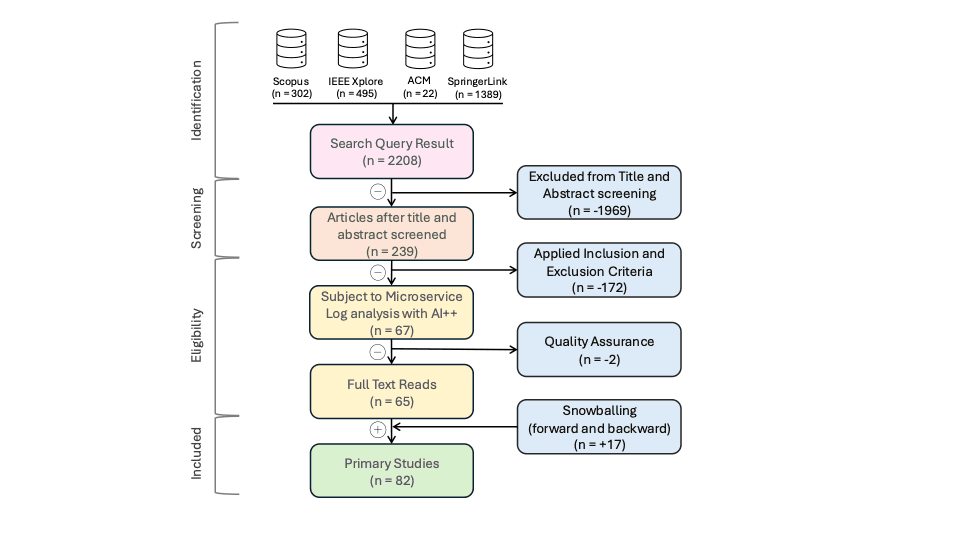
Our systematic literature review—accepted for publication in the Journal of Systems and Software (JSS)—analyzed 82 primary studies from 2,208 papers published between 2018 and 2025, examining how AI is being applied to microservice log analysis. The findings reveal both exciting progress and significant gaps between academic research and enterprise needs.
The Big Picture
Before diving into details, here's the landscape of AI-powered log analysis research at a glance:
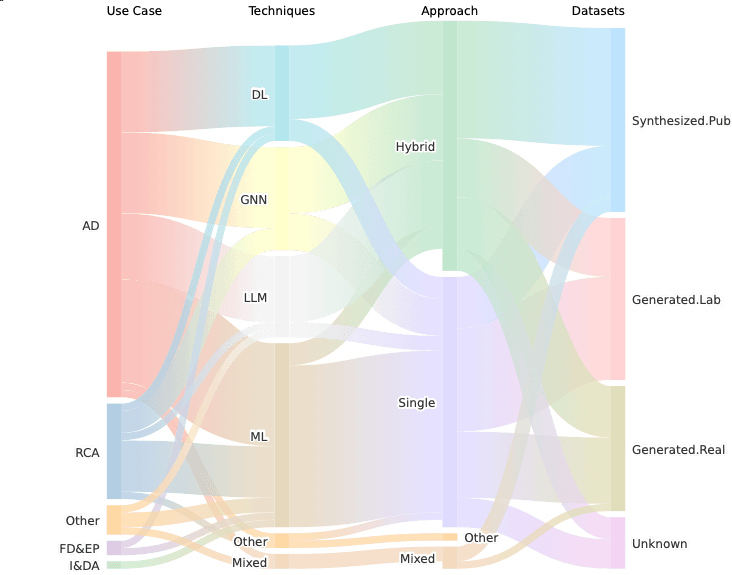
The flow tells a clear story: Anomaly Detection dominates the research (72% of studies), hybrid approaches are the preferred methodology (53.9%), and there's a concerning reliance on synthetic or private datasets (79.3%).
What AI Techniques Are Researchers Using?
We identified 87 distinct AI techniques across five major categories. Here's how they break down:

Hybrid approaches lead the pack (53.9% of studies), combining the strengths of multiple techniques. Deep learning comes in at 27.6%, followed by GNNs at 19.5%. LLMs, while powerful, still represent only 12.6% of studies—likely due to their computational demands.
Key Trend
The research trajectory is clear: early work focused on traditional ML methods, while recent studies increasingly leverage transformers, LLMs, and GNN-based hybrid architectures that can capture complex service interdependencies.
Why Different Techniques Excel
| AI Category | Usage | Best For |
|---|---|---|
| Deep Learning | 27.6% | Pattern recognition across diverse log formats |
| GNNs | 19.5% | Modeling service dependencies and call graphs |
| LLMs | 12.6% | Semantic understanding without manual parsing |
| Traditional ML | 16.1% | Resource-constrained environments, interpretability |
| Hybrid | 53.9% | Complex enterprise scenarios requiring multiple capabilities |
The Anomaly Detection Bias
Not all log analysis tasks receive equal attention. Here's where researchers focus their efforts:
| Use Case | % of Studies | Maturity |
|---|---|---|
| Anomaly Detection | 72% | Most mature, many open-source tools |
| Root Cause Analysis | 18% | Growing but challenging |
| Fault Diagnosis | 6% | Significantly underexplored |
| Dependency Modeling | 4% | Critical gap for practitioners |
The Missing Pieces
Detecting an anomaly is only useful if operators can quickly identify its cause. The relative neglect of fault diagnosis (6%) and dependency modeling (4%) represents a significant research-practice gap.
The Dataset Problem
Perhaps the most significant finding is the disconnect between research environments and real-world conditions. 79.3% of studies use synthetic or private datasets—raising serious questions about generalizability.
Models trained on clean, well-structured synthetic data may struggle with the noise, inconsistency, and scale of production logs. Only 20.7% of studies use public benchmarks.
Public Datasets Available Today
For researchers looking to improve reproducibility:
| Dataset | Source | Size | Primary Use |
|---|---|---|---|
| HDFS | Hadoop Distributed File System | ~1.5GB | Log parsing, anomaly detection |
| BGL | Blue Gene/L supercomputer | ~700MB | Failure prediction |
| Thunderbird | HPC cluster (USENIX) | 1.9GB | System diagnostics |
| OpenStack | Cloud infrastructure | Varies | Trace analysis |
| TrainTicket | Microservice demo app | Varies | End-to-end testing |
Tools You Can Use Today
Our review identified numerous open-source implementations. Here are the most notable tools across different categories:
For Anomaly Detection (Sequence-Based)
- DeepLog — LSTM-based approach that learns sequential log patterns. The foundational work that many later tools build upon.
- PLELog — Combines attention-based GRU with hierarchical classification. Great for scenarios with limited labeled data.
For Anomaly Detection (Transformer/LLM-Based)
- LogBERT — Template-free log analysis using pre-trained BERT. Eliminates the need for manual log parsing.
- LasRCA — Uses GPT-4 for in-context reasoning to explain and classify anomalies. Shows promise for one-shot root cause analysis.
For Dependency-Aware Analysis (GNN-Based)
- DeepTraLog — Models spatial-temporal trace event graphs for systems with complex service dependencies.
- TraceAnomaly — Unifies invocation path and response time analysis using deep Bayesian networks.
Supporting Infrastructure
- HuggingFace Transformers — Pre-trained models for building custom log analysis solutions
- PyTorch Geometric — GNN implementations for graph-based analysis
- LogHub — Collection of system log datasets for benchmarking
Performance: The Good and The Concerning
What's Working
When AI techniques work, they work impressively well:
| Achievement | Result |
|---|---|
| F1 Score improvement | 4.5% – 19.3% over baselines |
| Real-time processing | <5 seconds for 5,000+ services |
| Hidden failure detection | 88.9% accuracy |
| RCA accuracy gains | 18-20% improvement |
What's Challenging
However, deployment challenges remain significant:
- 56% of studies report data limitations (label scarcity, quality issues, log heterogeneity)
- 51% of studies face reliability concerns (false positives, concept drift, model degradation)
- 50% of studies encounter resource constraints (GPU requirements, training time, inference latency)
The Production Gap
While AI techniques demonstrate strong benchmark performance, translating that to production environments requires addressing data quality, computational efficiency, and operational reliability concerns that many current approaches don't fully solve.
Recommendations
If You're a Researcher
- Prioritize realistic datasets — 79.3% of studies use synthetic data. Work with enterprise partners to access production logs.
- Address efficiency alongside accuracy — 50% of studies report resource constraints. Production systems need lightweight solutions.
- Explore the gaps — Fault diagnosis (6%) and dependency modeling (4%) are underserved but critical for practitioners.
- Design for drift — Production logs evolve continuously. Online learning approaches are needed.
If You're a Practitioner
- Start with anomaly detection — It's the most mature area with many open-source tools available.
- Evaluate resource requirements first — LLMs require significant GPU resources. Consider your infrastructure constraints.
- Consider hybrid approaches — 53.9% of studies use hybrid methods for good reason—they combine multiple strengths.
- Invest in log standardization — OpenTelemetry reduces the "instrumentation tax" and makes AI adoption easier.
Looking Ahead
Several trends point toward the next generation of log analysis AI:
LLM Integration — Large language models show promise for semantic log understanding, but computational costs need optimization. Tools like LasRCA demonstrate potential for one-shot root cause analysis.
Hybrid Architectures — Combining GNNs (for dependency modeling) with transformers (for sequence understanding) addresses both structural and semantic understanding needs.
Enterprise-Realistic Benchmarks — The community needs new datasets that capture production complexity—including noise, schema drift, and multi-tenant scenarios.
Federated Learning — Privacy-preserving techniques like AFALog could enable cross-organization learning without exposing sensitive log data.
Methodology
Our systematic review followed PRISMA guidelines, searching across Scopus, IEEE Xplore, ACM Digital Library, and SpringerLink.
Citation
@article{uddin5768479microservice,
  title={Microservice Logs Analysis Employing AI:
         A Systematic Literature Review},
  author={Uddin, Md Arfan and Weerasinghe, Shakthi
          and Gajewski, Darek and Akbarsharifi, Melika
          and Akbarsharifi, Roxana and Stoner, Christopher
          and Cerny, Tomas and He, Sen},
  journal={Available at SSRN 5768479}
}
About This Research
This work was conducted at the University of Arizona with support from the National Science Foundation. Our team combines expertise in software engineering, distributed systems, and machine learning to address real-world challenges in microservice observability.
The paper has been accepted for publication in the Journal of Systems and Software (JSS). The full paper includes detailed methodology, complete technique taxonomies, and extended analysis of each primary study. The complete replication package is available on Zenodo.
Appendix: Complete Tool Reference
For practitioners looking for a comprehensive reference, here's the full catalog of tools and techniques identified in our review.
Sequence-Based Tools (LSTM/RNN)
| Tool | Technique | Use Case | Key Innovation | Source |
|---|---|---|---|---|
| DeepLog | LSTM Neural Networks | Anomaly Detection | Learns sequential log patterns to detect abnormal events | Code |
| LogAnomaly | LSTM + Template2Vec | Anomaly Detection | Captures structure and semantics of logs | — |
| PLELog | Attention GRU + HD-CNN | Anomaly Detection | Label estimation with hierarchical classification | Code |
| LTTng-LSTM | LSTM + LTTng Tracer | AD, Debugging | Distributed tracing with NLP analysis | Code |
| MAAD | CNN + LSTM + FCN | Anomaly Detection | Distributed multi-agent architecture | Code |
Transformer and LLM-Based Tools
| Tool | Technique | Use Case | Key Innovation | Source |
|---|---|---|---|---|
| LogBERT | BERT Language Model | Anomaly Detection | Template-free log-sequence AD using pre-trained BERT | Code |
| LogLLM | BERT + LLaMA | Anomaly Detection | Hybrid transformer encoders for contextualized AD | Code |
| LogFiT | RoBERTa + Fine-tuning | Anomaly Detection | Adapts pre-trained transformers to log formats | — |
| LogELECTRA | ELECTRA + Self-supervised | Anomaly Detection | Efficient masked discrimination with minimal labels | — |
| LasRCA | GPT-4 + Prompt Tuning | AD, RCA | In-context LLM reasoning for anomaly explanation | Code |
Graph Neural Network Tools
| Tool | Technique | Use Case | Key Innovation | Source |
|---|---|---|---|---|
| TraceCRL | GNN + Contrastive Learning | AD, Dependency | Preserves graph structure with operation-level embeddings | Site |
| DeepTraLog | GGNN + DeepSVDD | AD, Dependency | Models spatial-temporal trace event graphs | Code |
| PUTraceAD | GNN + PU Learning | Anomaly Detection | Span causal graphs with positive-unlabeled learning | Code |
| DiagFusion | GNN + FastText | RCA, Dependency | Multi-source observability fusion | Code |
| TraceAnomaly | Deep Bayesian + Posterior | AD, Dependency | Unifies invocation path and response time analysis | Code |
Active Learning and Human-in-the-Loop Tools
| Tool | Technique | Use Case | Key Innovation | Source |
|---|---|---|---|---|
| AcLog | LSTM + Active Learning | Anomaly Detection | Integrates human knowledge for few-shot learning | Code |
| AFALog | Active Learning + Transformer | Anomaly Detection | Mitigates class imbalance with active feedback | Code |
| ServiceAnomaly | Annotated CPG + Classifier | AD, Dependency | Constructs causal context graphs for anomalies | Code |
| UAC-AD | Transformer + CNN + GAN | Anomaly Detection | Adversarial training with contrastive learning | Code |
Supporting Frameworks and Libraries
| Resource | Type | Description | Link |
|---|---|---|---|
| HuggingFace Transformers | Library | Pre-trained transformer models (BERT, RoBERTa, etc.) | Docs |
| PyTorch Geometric | Library | GNN implementations for graph-based learning | Docs |
| OpenTelemetry | Standard | Observability framework for traces, metrics, and logs | Docs |
| LogHub | Dataset | Collection of system log datasets for benchmarking | Code |
| MEPFL | Framework | Ensemble-based detection using trace and metric signals | Site |